


Q&A With Lidis Garbovan: What we can learn from the UK LLC Citizen Panel
When Understanding Patient Data first proposed a learning governance model in 2021, the idea was simple but ambitious, to move beyond one-off decisions about data access and create an ongoing feedback loop between organisations and the public.
At the UK Longitudinal Linkage Collaboration (UK LLC), Citizen Panel lead researcher Lidis Garbovan spent two and a half years putting that idea into practice through an innovative Citizen Panel. We spoke to Lidis about what happened, what was learned, and what it means for the future of data governance.
What was the Citizen Panel?
The Citizen Panel was a pilot research project at the UK Longitudinal Linkage Collaboration (UK LLC) at the University of Edinburgh that reviewed the UK LLC data access processes and provided public perspectives and recommendations. It was about creating an ongoing dialogue between citizens and the UK LLC research resource, rather than a one-off consultation.
How does it relate to UPD's learning governance model?
This project drew directly on UPD's concept of learning governance. The aim was to move public involvement in data governance from a one-way process to a feedback cycle. Panel members learned about UK LLC's governance processes and, over time, became confident enough to challenge and meaningfully influence those processes. Importantly, they were involved before decisions were made, not after.
This reflects UPD's vision of governance as a continuous cycle of learning, where public insight helps shape future decisions rather than simply commenting on past ones.
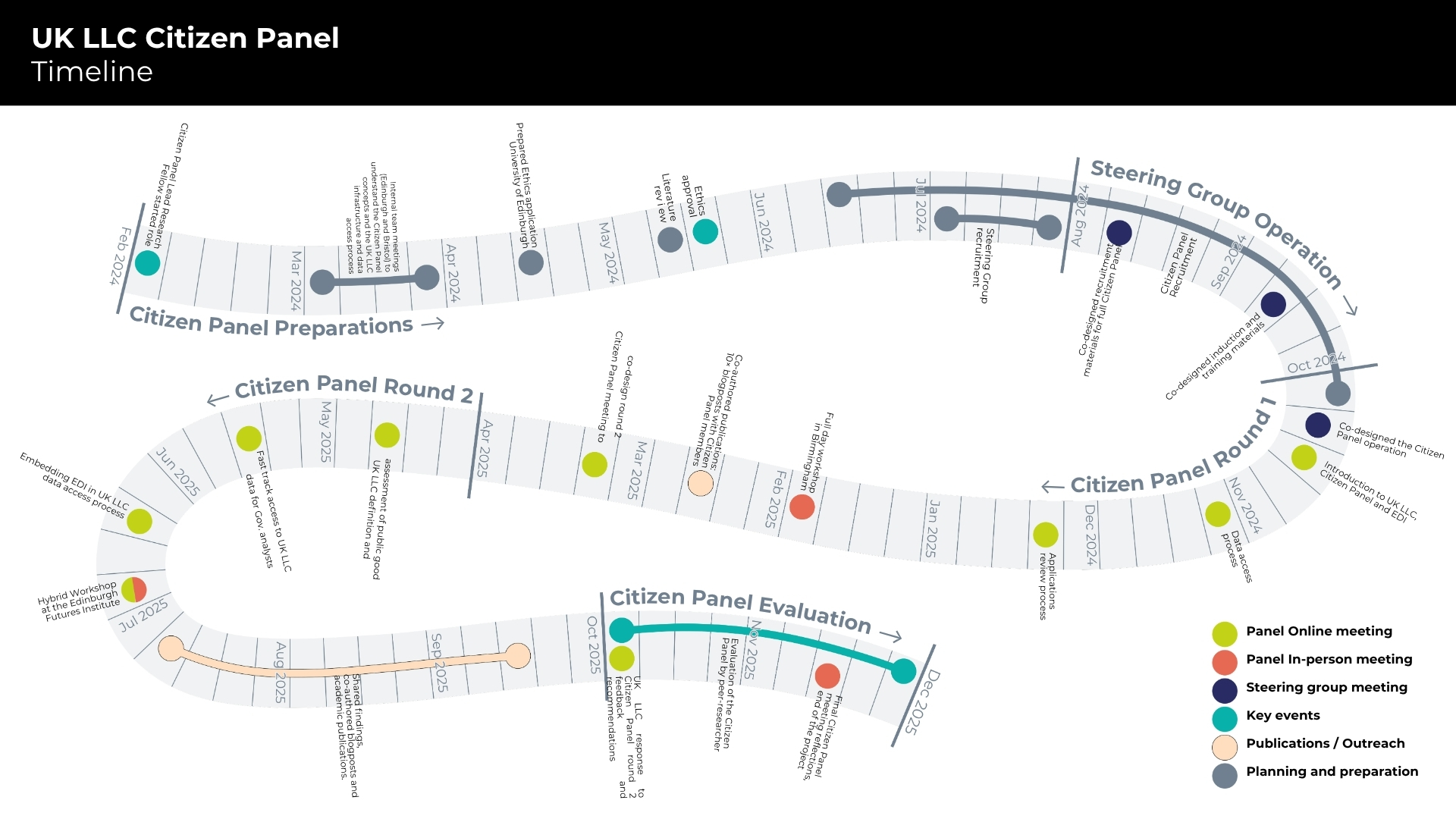
Download a copy of the timeline.
What made this different from traditional public involvement?
Several things!
The project brought together expertise from sociology, anthropology, health, data science and public involvement to set it up. The Panel itself included both participants from longitudinal studies and people from groups that are too often under-represented in research. We built the model over two years meaning over time the panel were able and confident to challenge the organisation about its governance and decisions, without fear of repercussions.
We also deliberately built flexibility into the model. Panel members were encouraged to bring their own experiences and ideas about what mattered. The Panel remained independent from UK LLC, and there were multiple rounds of dialogue rather than one-off engagement activities. This meant we had the time and space to learn together. That learning was reciprocal - the Panel learned about governance, while UK LLC learned how different communities understand research and data use.
What role did the Panel play?
UK LLC leadership described the Panel as a "critical friend who speaks truth to power".
The Panel scrutinised operations, how researchers access data, and how governance decisions are made. As time has gone on, members have gone from understanding how the existing system works to proposing how it could work better, including proposing frameworks defining public good guidelines, and embedding equality, equity, diversity and inclusion throughout the application process.
How did the learning loop work in practice?
The Panel produced recommendations in its first round of work. UK LLC then responded, explaining what could be implemented, what could not, and where further discussion was needed.
Those responses were openly discussed with the Panel. Members were invited to challenge, reflect on and respond to them in multiple rounds of dialogue. Topics for the second round of deliberations were chosen from themes emerging from the first round's recommendations and discussions with UK LLC.
This created the kind of feedback cycle envisaged in UPD's learning governance model, where recommendations, responses and further deliberation continuously informed one another.
What changed as a result?
There were several examples.
The Panel helped shape discussions about fast-track data access for government analysts, recommending that expedited access should only be permitted during a national emergency or demonstrable urgent need.
The Panel also recommended redesigning UK LLC's data access process visual map into a more transparent and circular model that better reflected the journey from application to published findings. UK LLC implemented this change.
More broadly, Panel members recommended expanding the model to consider emerging issues beyond data access, including AI and future research challenges. UK LLC subsequently funded the Panel to become a co-applicant on a major research funding proposal submitted earlier this year.
What did participants think?
Many participants started out worried the subject would be too complex or intimidating. By the end of the first round, they described themselves as "confident", "relaxed" and "excited", and said they felt valued.
One participant reflected:
"They listened. They changed meeting times, rewrote documents, even redesigned their process maps because we asked. Our experiences counted."
Another described the project as proof that "research can be done differently – with real partnership, not just consultation".
Read more about the participant experience in this blog.
What are the key lessons for organisations?
Meaningful public involvement requires time, genuine interest, and commitment from organisations. Leaders need to be willing to listen, engage directly with the public and act on what they hear.
It also requires involving people early to have meaningful influence, not as an add-on once decisions have already been made. Finally, it requires investment: time, resources, skilled facilitation and a willingness to build trust over time.
The most important lesson is to ensure that there is mutual respect, transparency and accountability between the public group and the organisation.
What's next?
The current funding for the UK LLC Citizen Panel ends in August 2026, but Lidis is exploring opportunities to scale the model into new areas including health research, policy, AI and ethics. Several academic papers on the methodology, impact and recommendations of the project are also due to be published. Lidis is keen to discuss ideas and proposals from organisations and leaders who are interested in the UK LLC Citizen Panel model.
For UPD, the project provides a real-world example of what learning governance can look like in practice - a governance model where public voices are part of an ongoing cycle of challenge, reflection and improvement.
Contact details: Lgarbova@ed.ac.uk. For UK LLC: comms@ukllc.ac.uk
Read the pre-print publication on the citizen panel, or read more about the impact of this panel in numbers.